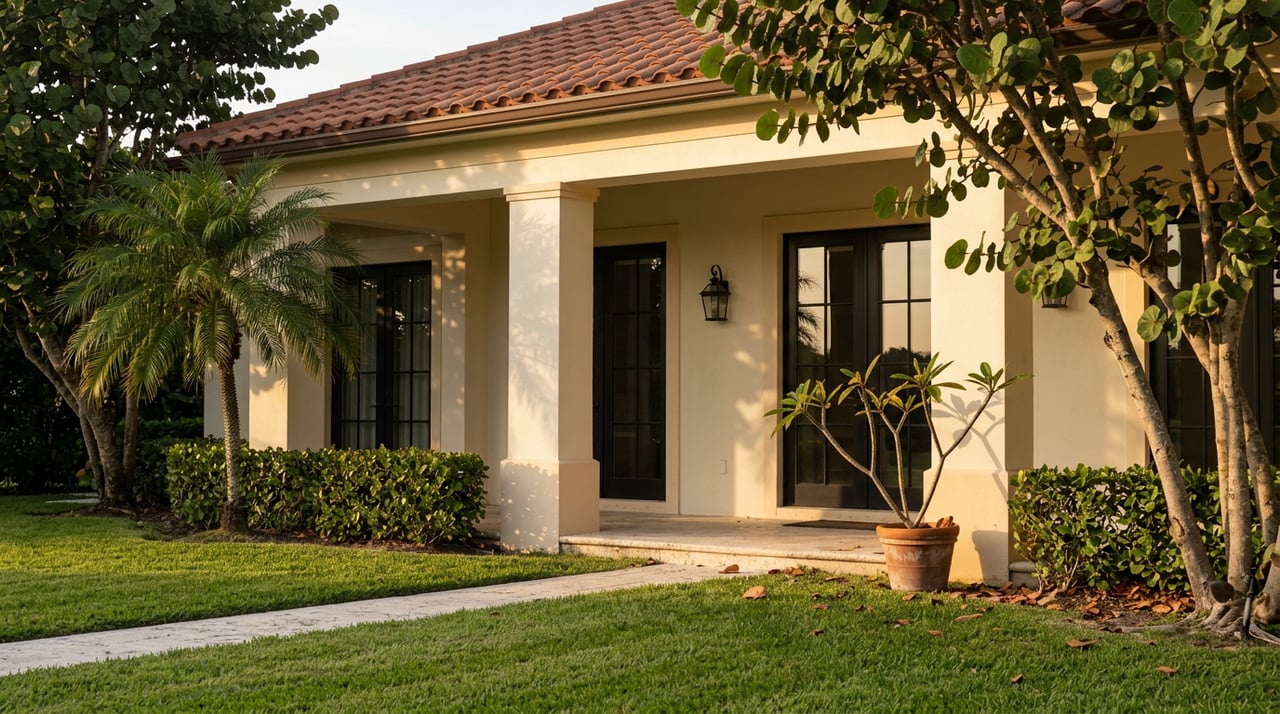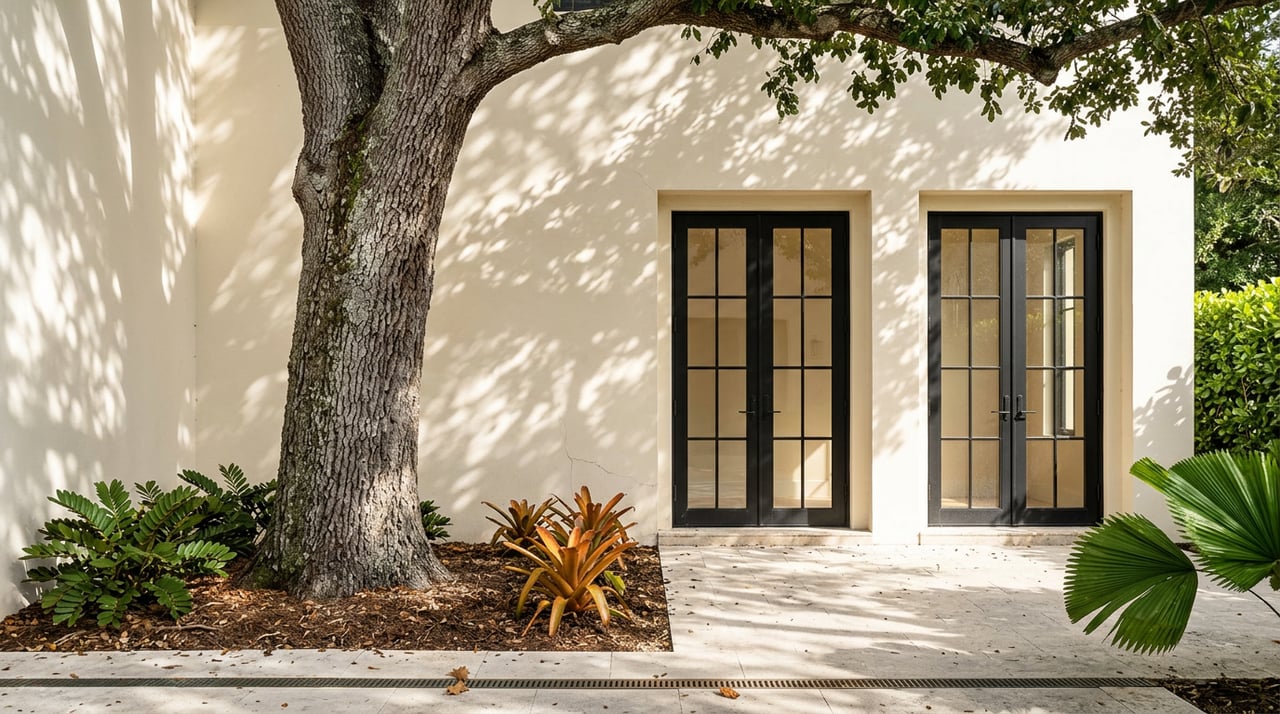
On Irvington Avenue in the South Grove, a 52-foot live oak with a 30-inch trunk was flagged for removal to accommodate a new home earlier this year. The homeowner had a permit path. The certified arborist who grew up on the street called the "sickness" attributed to the tree the polite word for false, according to Coconut Grove Spotlight. Neighbors organized. A moratorium demand followed. The permit is now the kind of file that keeps a site crew from mobilizing.
For an owner or architect starting a Miami estate in 2026, that story is not a Coconut Grove story. It is a site-planning story. The binding constraint on where a house sits is no longer setback, FAR, or the seawall line. On lots with mature canopy, it is which trunks measure eighteen inches or larger at four and a half feet off natural grade, and whether a ten-day public appeal window will close before the excavator arrives.
The 18-inch line that reorders a site plan
Miami-Dade defines a specimen tree as any individual trunk with a diameter at breast height of 18 inches or greater, measured 4.5 feet from natural grade, per the county's tree removal or relocation permit rules. That single number decides the review track. Below 18 inches, the removal is a routine permit. At 18 and above, the file moves into a full environmental review that can run beyond 30 days depending on completeness.
A second list narrows the field further. Live oak (Quercus virginiana), gumbo limbo (Bursera simaruba), and mahogany (Swietenia mahagoni), among other protected natives on Miami-Dade's schedule, are effectively un-removable without documented hazard, disease confirmation from a certified arborist, or a formal variance hearing. A specimen live oak inside a proposed footprint is not a design problem the landscape architect solves in DD. It is a decision the owner makes at schematic, or one the neighbors help make for them.
The clock that changed in May 2026
On May 14, 2026, the Miami City Commission established the Miami Tree Ordinance Advisory Committee, a ten-resident panel with two seats per commission district. The move followed an alert from Sierra Club Miami that generated more than 1,200 emails to city officials demanding a moratorium on tree removal permits, as reported by Coconut Grove Spotlight. The District 2 seats went to arborist Ian Wogan and Chris Baraloto, associate director of FIU's International Center for Tropical Botany at the Kampong.
"We're at war."
That was Albert Gomez, a former member of the city's Climate Resilience Committee, speaking at a community meeting at the Kampong the week before the vote. Seventy attendees were walked through the tree ordinance and its appeal process. The Spotlight's reporting counted 35 Miami properties with proposed removals or relocations subject to appeal on a single Friday in May.
The mechanism that matters here is the appeal window. Once the city posts an "intended decision" on a removal permit, a resident or abutting owner has ten days to file an appeal with the Historic and Environmental Preservation Board. The appeal fee is high enough that one Miami resident, Lindsay Cain, started a GoFundMe to cover it. Standing has been litigated, as Miami Today has covered alongside the FSU Consensus Center outreach the city commissioned in July 2025 to guide potential ordinance revisions.
For a builder, the ten days are a scheduling instrument. An appeal filed on day nine can push demolition, and everything downstream of it, into the next month. On a project where impact glazing and stone are already sitting in a bonded warehouse waiting to be released, that month is expensive.
What mitigation actually costs, in inches and dollars
Removal is not the end of the file. Miami-Dade requires inch-for-inch DBH replacement, and when a permit calls for ten or more replacement trees, the county's Planting Mitigation Guidelines require a minimum of 50% native species and cap palms at no more than 30% of the total. Where physical replanting cannot satisfy the requirement, the balance is paid into the county's Tree Trust Fund as an in-lieu contribution.
Translate that to an estate lot. A single 30-inch live oak, if removal is even permitted, is 30 inches of canopy to replace, and the replacements are counted by trunk caliper at planting. A twelve-foot hardwood at installation does not carry a 30-inch trunk. The math cascades. On a lot with three or four specimen trees inside a proposed footprint, the mitigation planting plan alone will reshape the setback of the pool, the width of the motor court, and the run of the pergola. If the site cannot hold the replacements, the Tree Trust Fund contribution becomes a line the estimator needs before GMP.
The Florida statute owners cite, and where it stops
Well-advised owners will bring up Florida Statute 163.045, the 2019 amendment that lets a residential owner remove a tree without a local permit when an ISA-certified arborist or a Florida-licensed landscape architect documents that the tree poses an unacceptable risk to persons or property, and that removal is the only practical mitigation. Miami Lakes and other jurisdictions publish the standard in their permit packages.
The statute is real. It is also narrow. It applies to residential property and to hazard-based removals. It is contested in application and does not, on its face, authorize the removal of a healthy specimen tree because it sits inside a proposed footprint. Development-driven removals still route through full environmental review. Treating 163.045 as a footprint tool has become one of the ways a Miami tree permit ends up in appeal.
A pre-construction sequence that treats trees as a schedule risk
The design-team habit of handling trees after schematic no longer fits the current climate. A working sequence for a Miami luxury build in 2026 looks closer to this:
- Commission an ISA-certified arborist tree survey with DBH tags and species identification before the architect finalizes siting. Every trunk 18 inches and above gets a numbered tag and a photograph.
- Overlay the specimen inventory on the proposed footprint at schematic. Protected natives inside the footprint become a design decision, not a permitting problem.
- Model two site plans: the preferred plan and a "no-specimen-removal" plan. The delta between them is the negotiating range for the owner.
- Price mitigation as an inch-for-inch replacement schedule plus a Tree Trust Fund contingency. Book both in the pre-construction estimate.
- Sequence the tree permit application so the ten-day HEPB appeal window closes before demolition mobilization, not before excavation. Assume at least one specimen file will draw attention.
- Retain the arborist through construction for the tree-protection barriers the city expects around retained trunks, and for the mitigation inspection at the end of the permit year.
The point of the sequence is not caution. It is that the tree file is now a schedule input on par with the survey, the geotech, and the impact-glazing lead time.
Miami Beach is a separate clock
Projects on the Beach follow the city's Urban Forestry process, not the county's tree program. Miami Beach tree work permits are valid for one year, an initial mitigation inspection is automatically scheduled two months before permit expiration, and a final inspection is completed one year after a successful mitigation inspection, per the city's tree work permit information. An estate project with a 14-month build carries a tree file that will still be open at certificate of occupancy. The closeout schedule needs to reflect that, or the CO conversation gets awkward.
FAQ
Does a tree survey belong in the due diligence budget on a Miami lot purchase? On any lot with visible mature canopy, yes. A one-day ISA arborist walk with DBH tagging is a small figure against the possibility that a specimen live oak or mahogany sits where the great room wants to be. It is easier to renegotiate a lot price during diligence than to redesign a house.
Can the Tree Trust Fund substitute for on-site replacement on a large estate lot? Only after available planting areas on the property have been maximized. The county and the beach both expect the site to absorb what it can, including through suspended soil systems and reduced impervious coverage, before an in-lieu payment is accepted for the balance.
What happens if trees come down without a permit during demolition? An after-the-fact permit is required, applicable fees are doubled, and the file becomes public. On a project already sensitive to appeal, an ATF is the kind of entry that draws the ten-day window on every subsequent removal from the same permit set.
Do the new advisory committee's recommendations already affect projects in permit today? The committee advises the commission and facilitates public feedback. It does not, on its own, change the ordinance. What it has changed is the visibility of individual permits, the speed at which residents learn about pending removals, and the likelihood that a specimen file will draw an appeal.
Ambitious design still gets built in Miami. It gets built by teams that treat the tree file as a pre-construction discipline, not a landscape afterthought. If you are planning a custom home or a significant renovation on a canopied lot in Coral Gables, Coconut Grove, Pinecrest, or Miami Beach, Jomed Construction can walk your site with your architect and arborist before the plan set is locked. Request a project consultation.